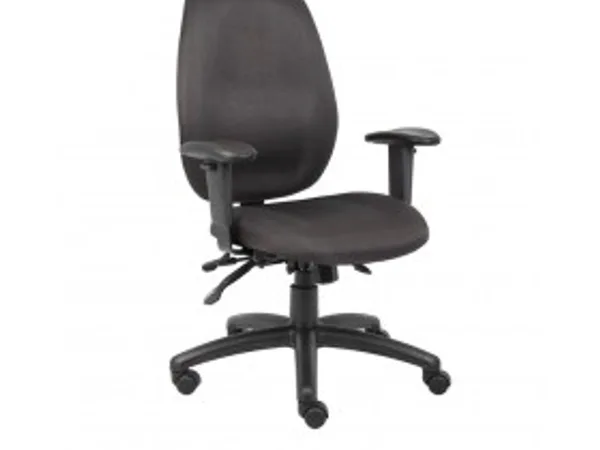
Casters are the cheapest moving part on a chair and the one buyers think about last. They are also a common source of returns, because the rule is the opposite of what people assume: hard wheels go on soft floors, soft wheels go on hard floors. Get that backwards and your customer either scratches their hardwood or fights the chair across the carpet all day.
Hard casters are for carpet
A hard nylon caster rolls easily on carpet because it sits on top of the pile instead of sinking into it. On low-pile office carpet it moves almost without resistance. The problem is what it does on a hard floor: that same unyielding nylon scratches and scuffs hardwood, laminate, vinyl and tile. So a hard caster is the right default for a chair going into a carpeted open-plan office, and the wrong one for a home office over a wood floor.
Soft casters are for hard floors
A soft caster is wrapped in a polyurethane or rubber tread. On hardwood, tile or laminate it grips gently, will not scratch, and runs noticeably quieter — which matters in a quiet office more than people credit. On carpet it works too, especially low-pile, but it drags a little more than a hard wheel. For any chair likely to live on a hard floor, soft is the safe spec.
Dual-surface casters, and the honest catch
Twin-wheel dual-surface casters are built to handle both carpet and hard floor, and the modern ones do it well — they are not the useless "universal" wheels of ten years ago. They are the pragmatic answer when you are selling into a market and do not know what floor the chair lands on. The catch is cost: a good dual-surface caster runs more than a plain hard nylon one, multiplied by five per chair and by the container. That is the trade-off — a few cents per wheel to cover an unknown floor, versus picking one floor type and accepting some returns from the rest.
Our default on a general office chair program is hard nylon, because most contract offices are carpeted. The moment you tell us the chairs are going to home offices or showrooms, we switch to soft polyurethane. If the destination floor is genuinely mixed, we quote dual-surface and let you see the per-chair delta.
Braked and locking casters — when they matter
Two more caster types come up on specific orders. Braked casters lock when the chair is empty and release under the user's weight, so the chair does not roll away as someone sits down — useful for drafting stools, lab chairs and anywhere a chair sits on a slope or near equipment. Locking casters stay locked until released by hand, for chairs that should stay put. Both add cost and both are over-spec for a standard desk chair, so we only put them on the lines that need them. If your buyer is fitting out a lab, a workshop or a school, ask the question; for a normal office, plain swivel casters are right.
Diameter, stem and the replacement problem
Caster stem diameter and wheel diameter both matter. A 60 mm or 65 mm wheel rolls over a cable, a carpet seam or a door threshold far more easily than a 50 mm one, which is why bigger wheels show up on chairs meant to move around. The stem has to match the base socket — usually an 11 mm grip-ring stem on office chairs, but it varies — and a mismatch means the replacement caster a customer buys later does not fit. We standardise stem and wheel size across a program and put both in writing, so a reorder of spare casters two years on still fits the chair. The base those casters plug into matters as much; for heavier users it has to be uprated, which we cover in our note on heavy-duty and 24/7 chairs.
One field note that saves arguments: casters are a wear part, so plan for replacement from the start. We can ship a small box of spare casters with a container so a reseller can swap a damaged one without an RMA, and on a branded program we keep the stem and wheel size consistent year to year. It costs almost nothing and it turns a "the wheel broke" complaint into a five-second fix. Casters are cheap; the goodwill they cost when they fail is not. And on a soft floor, that broken hard caster has usually scratched something on its way out — another reason to get the wheel-to-floor match right the first time.
Send us the destination floor type and the duty level, and we will spec a caster that does not come back as a complaint. We build to BIFMA / EN methods and testing can be arranged. Start at our contact page or browse the full seating range.