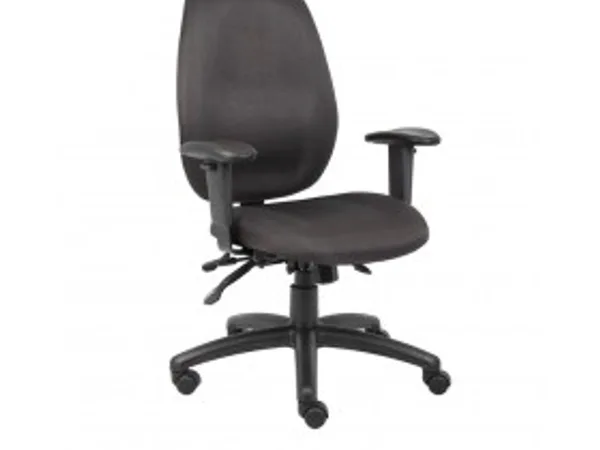
"What's the weight capacity?" is a fair question, but the number on the sticker is only the headline. A heavy-duty or 24/7 chair is a matched set of upgraded parts, and the rating is only as honest as the weakest one. A chair advertised at 180 kg with a gas cylinder rated for 120 kg is not a 180 kg chair — it is a 120 kg chair with optimistic marketing.
What changes on a real heavy-duty chair
Going from a standard task chair to a big-and-tall build is not a wider seat and nothing else. The seat plate gets thicker plywood or a reinforced pan. The gas cylinder steps up to a higher class rated for more load and more cycles. The five-star base goes from light nylon to reinforced nylon or aluminium so it does not crack at the spokes under a heavier user dropping in. The frame and the recline mechanism are uprated too. Skip any one of those and you have moved the failure point, not removed it. We spec the base, cylinder and mechanism together for the duty level, and quote the matched set on our ergonomic chair platforms.
40-hour is not the same as 24/7
This is the distinction buyers miss most, and it is a real one. A chair can be rated for a high static weight and still be warranted only for a standard 40-hour office week. A 24/7 chair — the kind that goes into a control room, a call centre running shifts, or a dispatch desk — is a different animal: it is sat in by different people around the clock, so the mechanism, foam and cylinder all have to survive far more cycles, not just more weight. Many "400 lb" executive chairs on the market are explicitly not warranted for multi-shift use. If your customer runs shifts, you need a chair built and rated for it, and the warranty has to say so.
The trade-off, stated plainly
Heavy-duty parts cost more and weigh more. For a normal office where users average a standard weight and work one shift, building everything to 24/7 big-and-tall spec is money spent on numbers nobody reaches — and the extra weight eats into your container count. But for a market with a heavier average user, or for any 24/7 station, under-building is the expensive mistake: a cylinder that sinks or a base that cracks comes back as a replacement plus freight plus an angry reseller, which dwarfs the upgrade cost. We would rather match the build to the duty than sell you either extreme.
Width and depth, not just weight
"Big and tall" is two words for a reason. A higher weight rating is about strength; "tall" is about dimensions. A heavier or larger user needs a wider seat and often a taller, wider back — a standard 480–500 mm seat that fits the average user is cramped for someone the chair is meant to accommodate. We widen the seat, deepen the cushion and raise the back on a true big-and-tall build, and we use a higher-density foam so the extra weight does not bottom the cushion out in a year. A chair rated for the weight but built on a standard-width seat is half a solution; the user is held up but not comfortable, and discomfort comes back as a return just like a structural failure does.
Read the warranty, not the headline
The warranty is where the duty rating gets honest. A chair sold for office use is typically warranted for a 40-hour week; a 24/7 chair has to be warranted for multi-shift use, and the document should say so in those words. We will not write a 24/7 warranty on a chair we built for single-shift duty, because that is a claim waiting to bite both of us. If your end customer runs a control room or a call centre across shifts, the warranty term is part of the spec — agree it before the order, and match the build to it.
How we rate it
When we quote a heavy-duty office chair, we tell you the rated capacity and the duty cycle it is built for, not just a sticker number. We build to BIFMA / EN test methods — including the higher-load and stability tests relevant to intensive-use seating — and testing can be arranged per order. If your buyer needs a stamped report for a 24/7 claim, decide that early, because it changes the timeline.
One sourcing tip that saves a return cycle: ask for the cylinder stamp photo and the base material in writing before production, not after. The two parts that quietly get downgraded on a "heavy-duty" chair are the gas cylinder and the base, because the buyer rarely sees them and the marketing number does not change. A genuine higher-class cylinder carries a mark you can ask to see — and if you want to understand what that mark means and the safety standards behind it, the gas lift safety guide is a useful reference — and a reinforced or aluminium base is visibly different from light nylon. Verifying those two before the deposit is cheaper than discovering them on a warranty claim.
Tell us the heaviest user you need to cover and whether the chairs run shifts, and we will spec a matched heavy-duty build and quote it honestly. Reach the desk via the contact form or read the buyer FAQ for lead-time and MOQ basics.