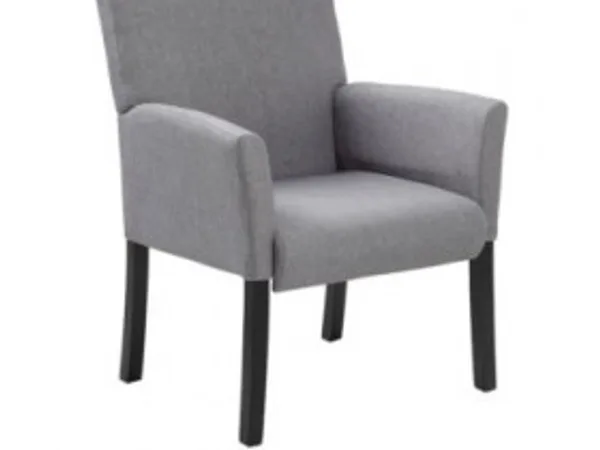
Two upholstered guest and conference chairs can look identical on the sample board and behave completely differently in service — one still tidy after five years, the other pilled and shiny in twelve months. The number that separates them is the Martindale rub count, and it is the single most useful spec to read on an office fabric. Most buyers either ignore it or over-buy it.
What the test actually does
The Martindale test (ISO 12947) clamps a fabric sample and rubs it against a standard abrasive in a figure-eight motion — a Lissajous curve — under a constant pressure of about 12 kPa, roughly the weight of a seated person. It runs in cycles and stops at the first visible wear: pilling, fraying or fibre break. The cycle count at that point is the rating. So a "40,000 Martindale" fabric took 40,000 rubs before it showed wear. It is a durability proxy, nothing more, but it is a reliable one.
The thresholds that matter for office seating
The scale is well established. Normal domestic use sits around 18,000–25,000 rubs. Heavy domestic is roughly 25,000–35,000. The number that matters for office and contract work is 30,000–40,000, usually labelled "moderate contract" or "commercial grade" — fine for private offices, meeting rooms and reception. For genuinely high-traffic public seating — busy open-plan, lobbies, healthcare waiting areas — you want 40,000-plus, "intensive contract." Above about 50,000 the extra rubs make little practical difference for an office chair; you are paying for a number the chair will never reach.
Why the number alone can mislead
Two honest caveats we give buyers. First, Martindale only measures abrasion. It says nothing about UV fading, stain resistance or how the fabric handles a spill — a high-rub fabric in a sunny office can still fade badly. Second, ratings are not strictly comparable between mills; one supplier's "40,000" is tested the same way but the fabrics behind the number differ. Fibre matters: polyester and synthetic blends generally outlast natural fibres, and a tight weave beats a loose one at the same weight. So read the rub count, but read the composition next to it.
Martindale or Wyzenbeek — know which your buyer uses
If your market is North America, your buyer may quote a different test entirely: Wyzenbeek (ASTM D4157), measured in "double rubs" rather than Martindale cycles. The two are not directly convertible — Wyzenbeek rubs in a straight back-and-forth line, Martindale in a figure-eight — so a Martindale 40,000 does not equal a Wyzenbeek number you can calculate. Europe and most of the rest of the world use Martindale; the US contract trade leans Wyzenbeek, where 15,000 double rubs is heavy-duty and 30,000-plus is the high end. The practical point: ask which test your customer's spec is written against, and we will source fabric tested to that one rather than handing you a number in the wrong currency.
Treatments matter as much as the rub count
For office seating, what kills a fabric is often not abrasion but stains and cleaning. A coffee spill or a cleaning chemical can ruin a high-rub fabric that would have outlasted the chair on abrasion alone. So for reception and shared seating we steer buyers toward fabrics with a stain-release or water-repellent finish, and for healthcare or food-service settings toward wipe-clean or antimicrobial options — sometimes a coated fabric or vinyl rather than a woven one. Those finishes change the hand-feel and the price, which is the trade-off. The rub count tells you how the fabric wears; the finish tells you how it survives real office life.
The trade-off
Higher rub counts cost more, and the jump from 30,000 to 50,000 is real money across a container of chairs. Here is the call: spec 30,000–40,000 for normal office and reception seating, and only step up to 40,000-plus on the lines headed for genuinely hard public use. Buying 60,000 for a private-office chair is the fabric equivalent of an aluminium base on a home chair — over-built for the duty. Match the rub count to where the chair sits, not to the highest number on the card.
We can source office fabric across that range and we will quote the Martindale figure and the composition in writing, not just a colour name. For chairs that also need a fire or content report, we say so up front and arrange the test.
One practical habit we ask buyers to keep: file the fabric spec with the rub count and composition alongside the order, so a reorder two years later lands on the same material. Fabric collections get discontinued, and "the same blue" from a different mill can carry a different rub count and a different hand. Recording the actual fabric — not just a colour name — is what keeps your second container matching your first, and it is the kind of detail a buyer can confirm during a factory audit.
Tell us where the chairs will sit and we will recommend a rub count and a fibre that fits the duty and the budget. Reach us through the contact form or see the seating range.