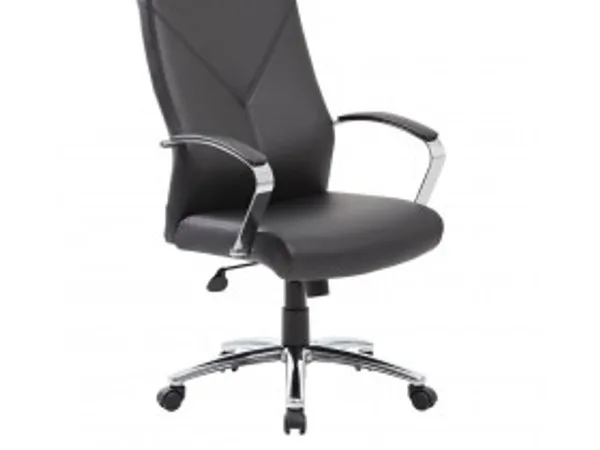
Most office chairs adjust height, recline and maybe the arms. Far fewer adjust seat depth, and that is the one a lot of users actually need. A seat-depth slider lets the seat pan move forward and back so the chair fits the length of the person's thigh — not the average thigh the seat was moulded for. For a contract buyer fitting out an office full of different bodies, it is one of the more useful mechanisms you can spec.
The number behind it
Ergonomic guidance is specific: there should be roughly 2–3 cm — about two or three finger widths — between the front edge of the seat and the back of the knee. Less than that and the seat edge presses into the popliteal fold behind the knee, the soft spot where blood vessels and nerves run. That pressure is what causes the numb, tingling or cold legs people complain about after a long day. More than that gap and the user slides forward off the backrest and loses lumbar support. A seat-depth slider is simply the part that lets each person hit that 2–3 cm window.
Who actually needs it
A fixed seat is built for a mid-height user and it is genuinely fine for them. The people it fails are at the ends: a tall user runs out of thigh support on a short seat, and a short user gets the front edge cutting behind the knee on a long one. If your chairs go to one known user, a fixed seat is cheaper and sensible. If they go into a shared open-plan office, a school, or a hot-desk setup where one chair serves many people, the slider stops a chunk of the comfort complaints that otherwise land on the reseller.
The trade-off, in cost terms
A seat-depth slider adds a mechanism, a few moving parts, and a bit of assembly time — so it adds cost, and on a tight budget line it is a fair thing to cut. Here is how we frame it for buyers: put the slider on the chairs that carry your brand and go into multi-user environments, and leave it off the entry-level SKU aimed at a single home user. You do not have to add it to the whole catalogue. Spending on a slider for a chair that one person uses all day is buying an adjustment they set once and forget.
It also pairs with the rest of the ergonomic chair spec — a synchro-tilt and an adjustable lumbar do more good when the seat depth is right first, because depth is the foundation the other adjustments sit on.
The two ways a seat actually slides
There are two common builds, and they are not equal. The cheaper one slides the whole seat pan on a rail under the seat, locking at set positions. The other moves the seat relative to the backrest, sometimes built into the mechanism. The rail type is simpler and is what most mid-range chairs use; the travel is usually around 50–60 mm, which covers the range of thigh lengths you meet in an office. What matters more than the type is the lock: it has to hold positively so the seat does not creep back when the user shifts their weight. A slider that drifts under load is worse than a fixed seat, because the user keeps re-setting it and eventually stops trusting it.
It only works if the rest of the chair cooperates
Seat depth is the base of the fit, but it interacts with the other adjustments. If the armrests are fixed and the seat slides forward, the arms can end up in the wrong place. If the backrest does not recline, a deeper seat just pushes the user away from the lumbar. So when a buyer specs a seat-depth slider, we look at the whole chair: it pairs best with adjustable arms and a working tilt, and it is wasted money on an otherwise fixed chair. The point of the slider is to let one chair fit many bodies, and that only pays off if the rest of the chair adjusts with it.
How we build it
Our sliders move the seat in steps and lock positively, so the seat does not creep back under load. We build the mechanism to BIFMA / EN durability methods and testing can be arranged per order — a slider that rattles loose after a month is worse than no slider, so the cycle count on the lock is part of what we check. Tell us whether your market expects this adjustment and we will quote it both with and without, so you can see the delta. The same logic applies across the mesh task range, where a sliding seat pairs naturally with a breathable back.
Send us the use case — single user or shared — and your target price, and we will recommend where the slider earns its cost. Reach us through the contact form, or see how we configure a branded run on the OEM / ODM page.