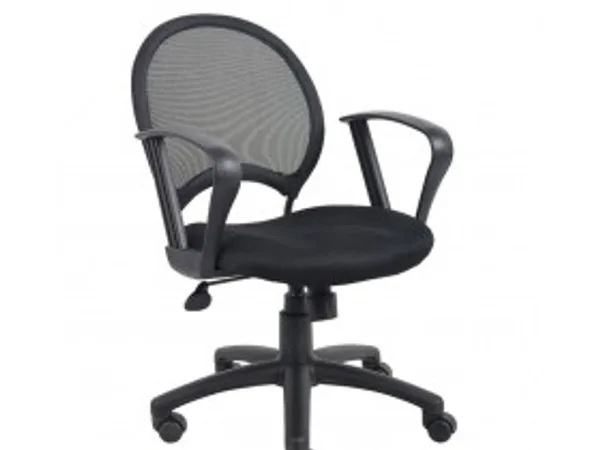
Buyers picture a mesh chair as "the fabric on the back," but on our line the mesh is one of the last things we worry about. The parts that decide whether a mesh task chair survives five years or sags in twelve months are the frame it is stretched over and the way that mesh is held under tension. Get those wrong and no grade of mesh saves the chair.
The back frame comes first
A mesh back is a frame with a membrane on it. We build that frame two ways. The cheaper one is glass-fibre-reinforced nylon (PA) moulded in one shot; the stronger one is a welded steel rod frame, sometimes wrapped, that takes more recline load before it flexes. Steel is heavier and costs more, and it is what we put under a high-back executive mesh chair that leans back all day. Nylon is fine on a mid-back task chair that sees lighter use. The frame is also where most warranty cracks start — at the corners, under recline load — so it is the part we test first, not the mesh.
Tensioning the mesh — the step you cannot see in a photo
The mesh itself is usually an elastomeric weave, and the trick is even tension across the whole panel. We stretch it onto the frame and lock it at the perimeter with a binding strip or an over-moulded edge. A panel that is pulled tight in the middle but loose at the corners is the one that sags first — and you cannot tell that from a showroom sample, because a new chair feels firm everywhere. You see uneven tension six months in, as a dip where the user's weight sits. Even tension and a properly reinforced edge are what we are paying for, and what a price-cut supplier quietly drops.
Tensioned mesh has one honest advantage over foam: airflow. The weave lets heat move off the back instead of trapping it, which matters far more in hot, humid markets than buyers expect. That is the real reason we steer Middle East and Southeast Asia programs toward mesh — covered in our note on mesh vs foam seats.
The trade-off we put on the table
Here is the call, stated plainly. An all-mesh chair (mesh back and mesh seat) is the coolest and lightest option, and it ships more units per container because it weighs less. But a mesh seat is harder to get right than a mesh back — sit on a thousand cheap mesh seats and you will find the edge digging into the thigh. For most office programs we recommend a mesh back with a thin moulded-foam seat: breathable where the body heats up, cushioned where it bears weight. It is not a compromise to dodge a decision; it is the build that generates the fewest complaints.
Where the lumbar fits in
A mesh back is not just a flat panel. The good ones carry a lumbar device — either a fixed moulded curve built into the frame or an adjustable lumbar that slides up and down and presses into the small of the back. The adjustable kind costs more and adds parts, but on a chair sold as ergonomic it earns its place, because a fixed lumbar sits at one height and fits one spine. We build both, and we will tell you plainly which one your price point can carry. A cheap "ergonomic mesh chair" with no real lumbar is just a mesh panel and a marketing word — the support has to be a physical part, not a curve printed on the brochure.
Assembly and the parts you do not see
Once the back is framed and tensioned, the chair is assembled with the seat, the tilt mechanism, the gas lift and the base — and a mesh chair lives or dies on how those join. The point where the mesh back bolts to the mechanism is a stress concentration; under recline it takes the load every time the user leans. We torque those fixings to spec and check them on the line, because a back that works loose is the complaint that follows a mesh chair more than torn mesh ever does. The seat under it, if it is foam, wants a density we can stand behind — covered in our note on mesh vs foam seats.
What to check before you confirm a mesh order
Three things, on us or on any supplier. Ask whether the back frame is nylon or steel and match it to the duty. Ask for a tension and recline cycle result, not just "it passed" — we build our mesh chairs to BIFMA and EN methods and testing can be arranged per order. And ask for the edge-binding detail in a photo, because that binding is what holds the whole panel. If a supplier cannot answer those three, the mesh grade on the quote is the least of your problems. The same checks apply when you audit a factory before the first order.
Tell us your market, your target retail price and whether you want all-mesh or mesh-back, and we will quote the frame and the tension spec in writing. Reach the export desk through our contact form or read how a private run works on the OEM / ODM page.