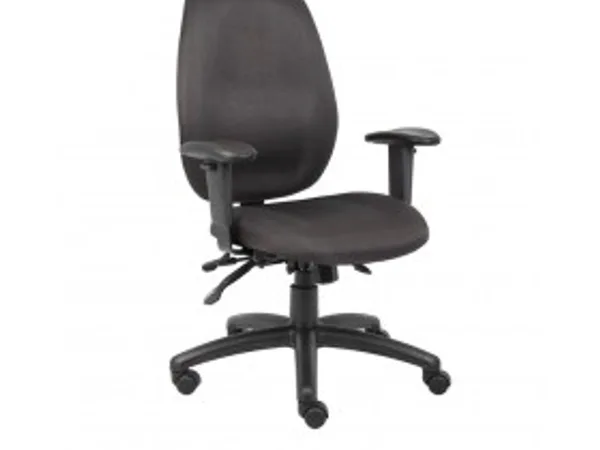
"Mesh or foam seat — which is better?" lands in our inbox most weeks, and there is no clean answer, because better depends on climate, price point and how the chair gets used. What we can do is tell you how each one ages and how the choice moves your costs. That is what should decide a wholesale program, not which sample feels nicer in an air-conditioned showroom.
How foam ages — and the number hidden in the quote
Foam comfort comes down to density, measured in kg/m³, and it is the spec most often buried in a cheap quote. A decent moulded seat foam for a commercial chair runs about 50–65 kg/m³. Below that, the seat feels fine new and then compresses — you get the visible dip and the user feels the hard front edge within a year of daily use. The catch is you cannot tell 40 kg/m³ from 55 kg/m³ by sitting on a fresh sample; you can only tell from the spec sheet and a cut test. That is why we put a density number on our office-chair quotes instead of writing "high-density" and leaving it vague.
How mesh ages
A well-tensioned mesh seat holds up for years, and it runs cooler because air moves through it instead of heat building up under the thighs. The failure mode is different from foam: it is the frame and the edge binding that give out first, not the weave — which is exactly the point we make in how a mesh chair is built. A cheap mesh on a thin frame sags at the corners; a properly framed and tensioned one does not.
The trade-off, by market
Here is the call we help buyers make. For hot, humid markets — the Middle East, Southeast Asia, the southern US — we lean mesh, or at least a mesh back, because it stays cooler and does not show the one-year sag that fills your inbox with complaints. For colder markets and for executive lines where buyers expect a padded seat, foam wins, but only if you hold the density line. The configuration that generates the fewest complaints across mixed markets is a mesh back with a moulded-foam seat: breathable where the body heats up, cushioned where it bears weight.
Not all foam is the same foam
If you go foam, there is a second decision under the density one: moulded versus cut foam. Moulded foam is shaped in a tool to a contoured seat, holds its shape well and gives a cleaner edge — it is what we use on most task and executive seats. Cut foam is sliced from a bun and wrapped, cheaper to set up and fine for flat cushions, but it does not hold a contour as crisply and a soft cut foam compresses faster. For markets with fire regulations on contract furniture, the foam may also need to be a flame-retardant grade, which is a different material and a different cost. We will tell you which foam is in the quote rather than letting "foam seat" stand for four different things.
The warranty angle
Seat choice shows up in your warranty claims, which is the number that actually matters to a reseller. A low-density foam that dips, or a cheap mesh that sags at the corners, both come back the same way — a photo, a complaint, a replacement. The few cents saved on a thinner foam or an under-framed mesh return as freight on spare seats and an unhappy customer. We would rather hold the seat spec where the chair carries your brand and only cut it on the genuine budget line, the same way we match parts to duty on a heavy-duty build.
It changes your container count too
Mesh chairs are lighter, so on a chair program you often fit more before you cube out — and with chairs you almost always cube out before you hit the weight limit. Foam executive chairs are bulkier and fill the space faster. So the seat choice quietly moves your landed cost per chair, not just the comfort. We factor that into the loading plan we quote rather than leaving you to find out at the port.
If you are still unsure, the safe move is to sample both. We will make a mesh-back version and a foam-seat version of the same chair so your team can sit on them and your market can react, rather than committing a container to a guess. A sample round costs days and a little money; a container of the wrong seat costs a season. That is the same reasoning behind the frame and tension we put into a mesh back in the first place — get the construction right at the sample, not at the port.
Send us your market and your target retail price and we will recommend a seat construction and put the foam density — or the mesh frame and tension — in writing. We build to BIFMA / EN methods and testing can be arranged. Reach us via the contact form or see the full range.